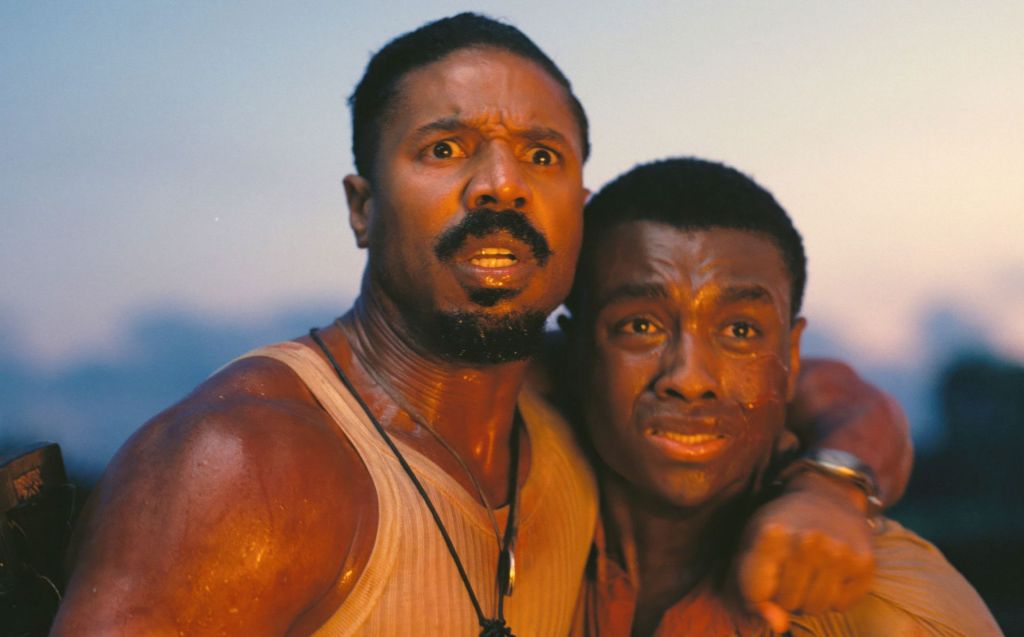
This post contains significant spoilers for the film. All images © Warner Bros.
Before award season draws to a close with the 2026 Oscars, I want to revisit one of the best, most surprising, and most rewarding films of the past year- Sinners. Written and directed by Ryan Coogler (Black Panther, Creed, Fruitvale Station), Sinners is one of the strangest and most original films we’ve ever seen from a major studio. It’s also one of the most profound. Sinners’ 137-minute runtime is both deeply personal and conceptually dense, packed with ideas, references, tensions, and unanswered questions ranging from race to religion to aesthetics and offering a window into Coogler’s worldview and philosophical beliefs.
To a writer, a movie as dense and significant as Sinners is a gift. It rewards multiple close watches and offers limitless opportunities for interpretation and analysis. Others have already written extensively about various aspects of the film, from its representation of Black musical tradition in America to the behind-the-scenes story of Coogler’s insistence on creative and commercial control over his project. I might write on these topics in the future, but for this piece, I’ll focus on an aspect of the film that I think has been largely overlooked- the connections it draws between art and spirituality.
Many viewers have glanced over the film’s spiritual elements as either simple plot devices or allegories for ‘real’ issues, but I think this is mistaken. Despite some fantastical elements, Sinners faithfully represents many genuine beliefs found in the African diaspora and the American South. It also makes a point of exploring the tension between modern Christian identity and the persistence of “ancestral” pre-Christian practices hailing from Africa or elsewhere. Lastly, Sinners draws a direct connection between spiritual practices and artistic creation. I believe this is a crucial part of the film’s message and deserves closer examination.
To better understand Sinners’ spiritual and artistic message, let’s start at the beginning.
Griots and Ancestors
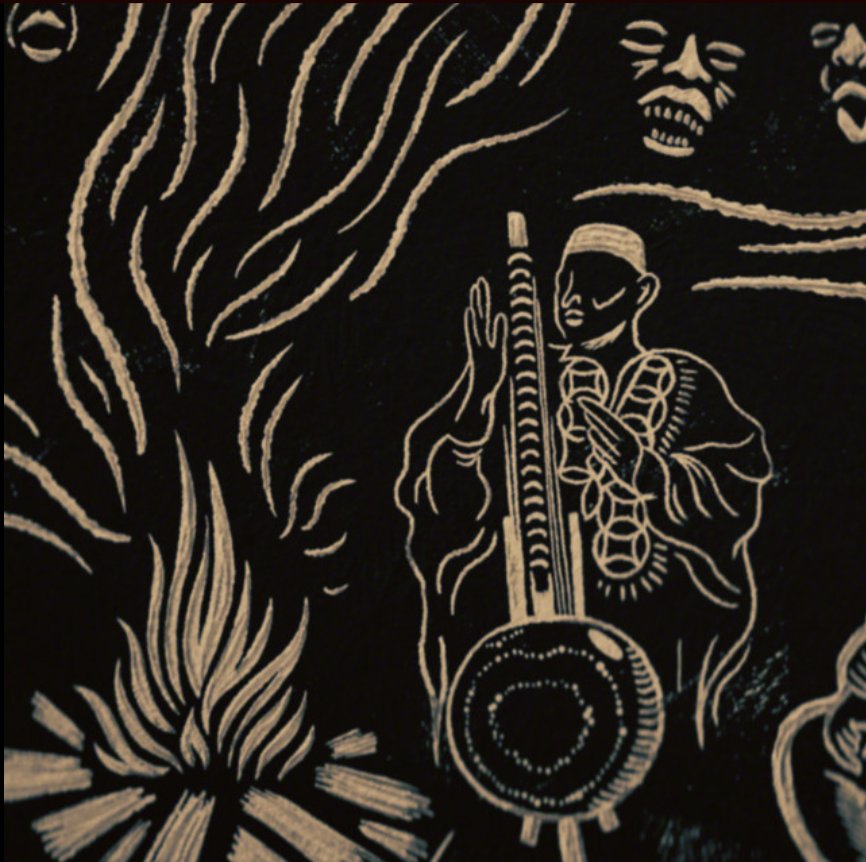
In the opening sequence of the film, a narrator (Wunmi Mosaku) describes musical and storytelling traditions from three different cultures, each embodied by a figure who was at once an artist, a historian, and a spiritual medium: the griot of West Africa, the filí of Ireland, and the firekeeper of the Choctaw nation. At first glance, this historical vignette seems to have little to do with the rest of the film. We never actually meet a griot, a filí, or a firekeeper in Clarksdale, Mississippi. But this sequence is Coogler’s mission statement, a crucial framing device for everything that follows.
In Sinners, Coogler’s first big-budget film under his full creative control, he steps into the role of a traditional epic storyteller, lending his individual voice and his mastery of a particular medium to the expression of a culture, a lineage, a history. Like a griot’s tale, Sinners is meant to simultaneously entertain, edify, and heal its audience. The film feels so unique and striking in large part because it sneaks these very old and very authentic modes of storytelling into the commercialized, industrialized medium of major studio filmmaking. That’s how Sinners manages to be so complex, so infinitely rewarding, while fitting cleanly into a standard movie format and runtime.
As a framing device, the introduction also tells us that Sinners is a story about storytelling and an artwork about art. In a revealing interview with The New Yorker’s Jelani Cobb, Coogler had this to say about the inspiration behind Sinners (emphasis mine):
I realized, “Oh, man, you can make the argument that Delta blues music is the most important American contribution to global popular culture.” You can make that argument. These people were important, bro… They were just human beings trying to make it under a back-breaking form of American apartheid…
That act of affirmation of that humanity, that deserves epic treatment, too. It deserves the most epic treatment… I said, “Man, I got to go for it.” Because this music, it changed the world, and these people had nothing.
There you have it. Coogler intended to create a true epic commemorating the people of the Mississippi Delta and the art form they created, the Delta blues. Artistic creation is a way to affirm and defend one’s humanity, and the humanity of one’s entire community, even in the face of dehumanizing forces like segregation and sharecropping. The creation of the blues by Black musicians in Jim Crow Mississippi was an act of courage and resilience that deserves to be retold as an epic. And as we see in the film’s opening sequence, epic storytellers entertain, educate, and heal by adding their own unique, individual contributions to the shared narratives of an entire community. Sinners is Coogler’s original epic, honoring the humanity and creativity of a past generation and, in doing so, re-affirming the bonds between his own generation and the ancestors.
Delta Spiritualism
One of the foundational stories in blues folklore is the deal at the crossroads. A young man, aspiring to become a legendary blues musician, meets the devil at a crossroads. The devil offers him unnatural musical ability in exchange for his immortal soul, and the young man accepts the Faustian bargain. In some versions of the story, the crossroads is in Clarksdale and the young bluesman was Robert Johnson– a Mississippi native who in the early 1930s would have been about the same age as the film’s character Samuel (Miles Caton). Or it may have been Tommy Johnson (no relation), another Mississippian who would have been about the age of the Smokestack twins (Michael B. Jordan) at the time. Other versions claim that the being waiting at the crossroads was not the devil of Christianity, but a benevolent West African deity named Papa Legba who serves as the intermediary between human beings and the supreme God.
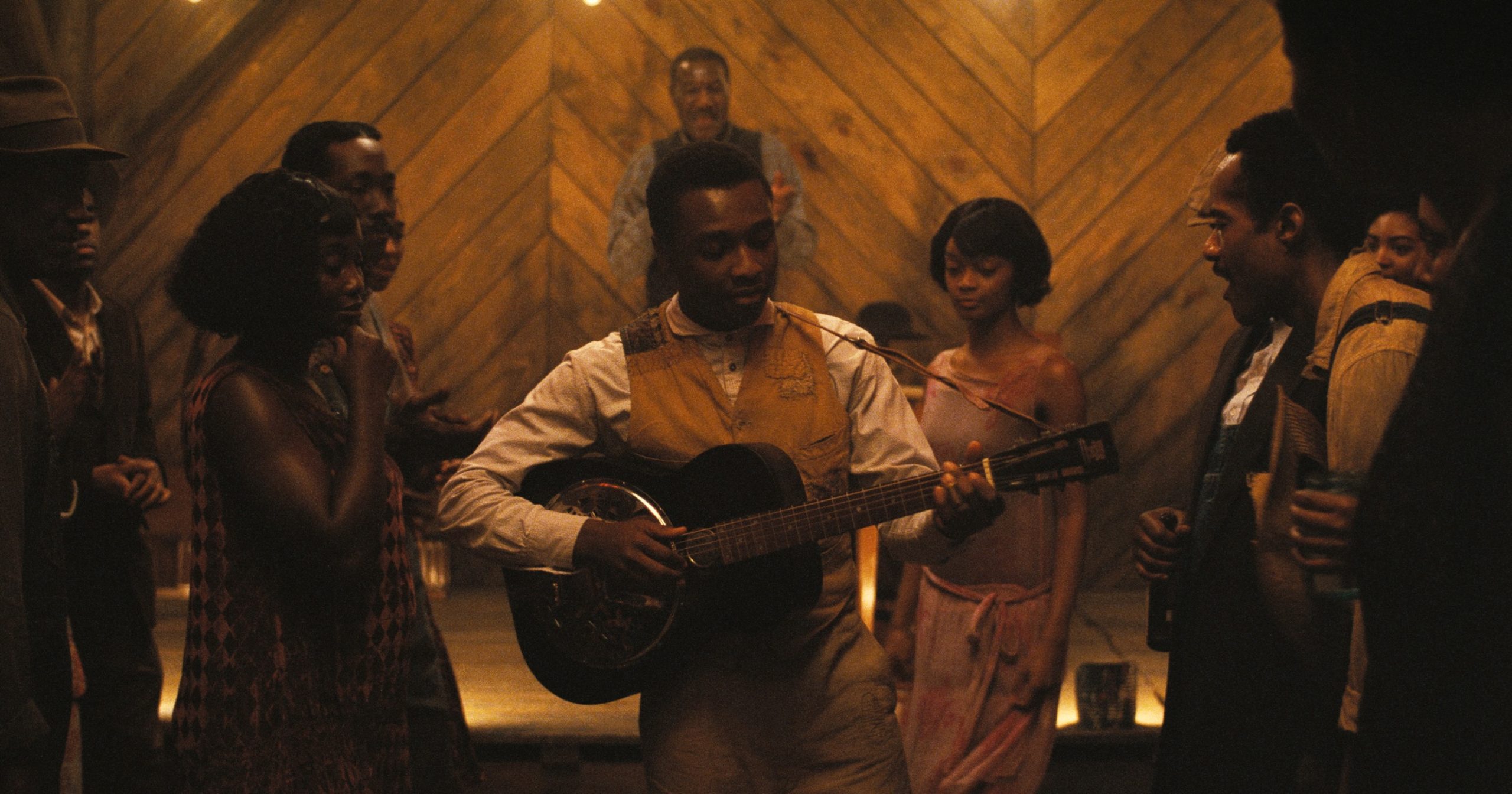
So did the young bluesman receive a satanic curse, or a divine blessing? Sinners leans into this ambiguity through the character of Samuel, also known as “Preacher Boy.” His pastor father sees blues music as shameful and literally demonic, but Samuel loves the blues and has a powerful gift for it. In the film’s central scene, he plays for the audience at the juke joint and conjures spirits from both past and future to join the living in dance. But this expression of music’s spiritual power also calls out to the vampire Remmick (Jack O’Connell), setting the horrific events of the night into motion. After surviving his ordeal with the vampires, Samuel chooses to become a professional musician in Chicago and turns his back on his father’s church.* He is the principal hero of Coogler’s epic, who remains committed to his role as artist and storyteller despite challenges and tribulations.
* As a Mississippi-born bluesman in midcentury Chicago, Preacher Boy’s peers would have included legends like Howlin’ Wolf and Muddy Waters
The scene where Samuel plays “I Lied to You” in the juke joint deserves a closer look. When he plays, he summons spirits from the distant past and the future- ancestors performing music and dances from West Africa as well as descendants playing rock, funk, and hip-hop and doing contemporary dances. The sequence is a powerful visual representation of the lineage of Black music in America. But this is not simply a visual metaphor. It also functions as a literal depiction of how some religious traditions understand the relations between the dead, the living, and the not-yet-born, and forms a key part of the film’s spiritual message.
In religions that practice ancestor veneration, including the Hoodoo faith practiced by Annie (Wunmi Mosaku again), practitioners see themselves as maintaining ongoing relationships with the spirits of the dead, who are believed to be close at hand and able to interact with the world of the living. Conversely, they believe that after they die, they will remain in contact with future generations through the very same practices. This is not a New Age invention- these types of beliefs are surprisingly common worldwide, appearing not only in African diasporic faiths like Hoodoo and Vodun but in many different regions and contexts. This notion that the living individual represents just one link in a chain reaching backwards through innumerable generations of the dead and forward through untold generations of the not-yet-born is not an allegory, but a sincere religious belief held by many traditions around the world.
A similar concept was applied in Coogler’s Black Panther films, where one of the superhero’s powers was access to the “ancestral plane.” This earlier appearance in a Marvel movie may have primed viewers to write off ancestor talk as simple worldbuilding, lore in the sense of fictional backstory rather than genuine tradition. But Sinners is at pains to show us that these ideas are meant to be taken literally and seriously. Annie, the film’s only explicit Hoodoo practitioner, is depicted as the wisest character in the film, a pillar of her community, and an elevating spiritual influence on her partner Smoke. To ensure an accurate and respectful depiction of Hoodoo practices, Coogler even hired a professor of religious studies to serve as “Hoodoo consultant” to the cast and crew. Clearly, this is an integral part of the film’s message about creativity and spirituality.
What is a Vampire?
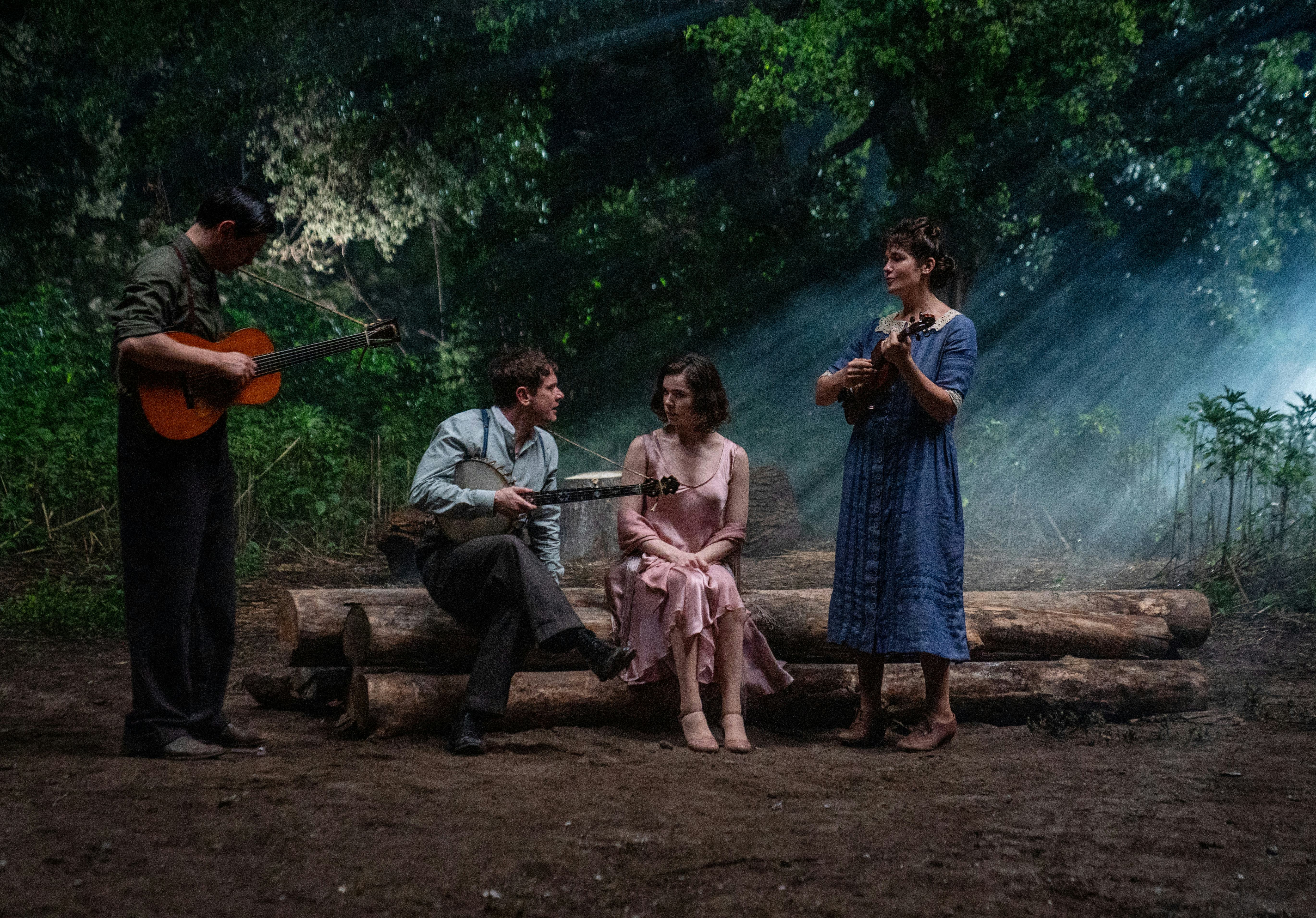
So far, we’ve seen how ideas about the relationship between spirituality and art run through the first half of the film. From the introduction, which frames Sinners itself as part of the lineage of epic storytelling, to Samuel’s embodiment of the ambiguous crossroads myth, to Annie’s expression of distinctly African spirituality, we’ve seen how these elements are woven throughout the story and characters. But there is one crucial piece we haven’t addressed yet- the villain.
In my next post, we’ll look more closely at the vampire Remmick. What does he represent? What does it mean to be undead in a story about ancestors and descendants? What does his Irishness signify? And what does his conflict with the film’s heroes tell us about the risks and dangers of artistic creation? Next week, we’ll see how all this and more ties back to the film’s central message.
 Taylor H Lunsford
Leave a comment